
Why Young Americans Are Rethinking the System
Why Young Americans Are Rethinking the System
2/17/20262 min read
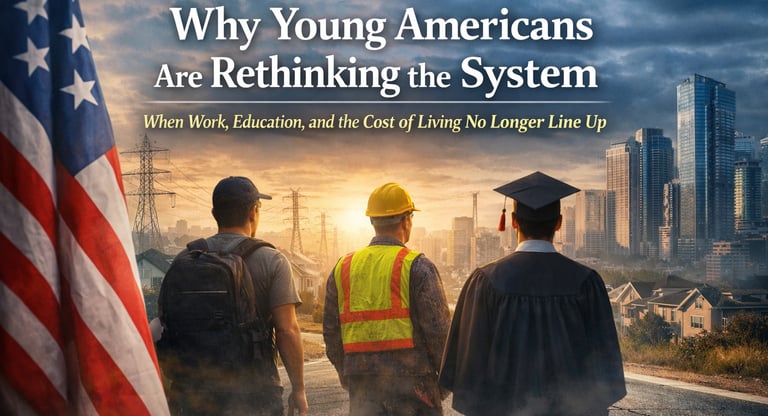
I’ve always believed in capitalism.. I believed in work, ownership, responsibility, and the idea that if you put in the effort, you could build a life. I still believe in much of that.
But when a growing number of Americans—especially younger ones—begin questioning the system or even flirting with socialism, it’s worth asking why instead of dismissing them as lazy or entitled.
That explanation no longer holds up.
It simply isn’t credible to suggest that millions of people—many of them educated, employed, and working long hours—are all lazy, whining, or looking for something for nothing. That kind of thinking avoids a harder question: what if the system no longer functions the way it promised to for people who are doing exactly what society told them to do?
At the same time, it would be dishonest to pretend there isn’t a segment of society that has become systemically dependent on government assistance. That problem exists and it needs to be addressed. But these are two separate failures.
A system that traps working people and one that enables dependency are both broken—but they are not broken for the same reasons, and fixing one does not excuse ignoring the other.
When people in their late 20s or 30s say they’ve been working since they left college, carrying debt, holding down one or even two jobs, and still can’t get ahead—that frustration isn’t imaginary. It’s measurable.
Over the past 30–40 years, real wages for the median worker have barely grown after inflation—roughly 10–15%. Over that same period:
- Housing prices have risen more than 200%
- Rent has doubled in many metro areas
- College tuition has increased far faster than inflation
- Healthcare and insurance costs have outpaced wage growth
- Childcare often rivals rent or a mortgage
These are not luxury expenses. They are the cost of basic functionality in modern America.
We tell people to invest in education, but the return on that investment depends heavily on what you study. For doctors, engineers, and certain technical fields, the math can still work. For many others, it doesn’t. Debt arrives immediately. Wage growth does not.
The American Dream used to be backed by policy. My father-in-law came from nothing, went into the military, and used the GI Bill—first to gain practical skills, then to pursue higher education. With affordable housing within reach, he was able to build a professional life from the ground up.
That wasn’t luck. It was structure. That structure no longer exists. Today, first-time buyers need $80,000–$100,000 just for a down payment, near-perfect credit, and stable income—often while competing with institutional investors.
At the same time, this country cannot fill thousands of good-paying jobs in the trades: plumbers, electricians, mechanics, welders, HVAC technicians, truck drivers. These are skilled careers that can support families without decades of debt.
We stopped valuing trades. Schools stopped promoting them. Society told kids that success only runs through college. That was a mistake.
If corporations are making record profits, then real responsibility means reinvesting in the workforce and society that made that possible. Partnering with high schools to build accountable trade pathways—based on attendance, performance, and discipline—is not charity. It’s investment.
Output is what matters.
Systems are judged by what they produce, not by what they promise. If effort no longer produces stability, belief collapses. If capitalism wants to endure, its output must match its ideals.
That’s the reality young people are responding to—and it’s a reality we can no longer afford to ignore.
John F Lorne